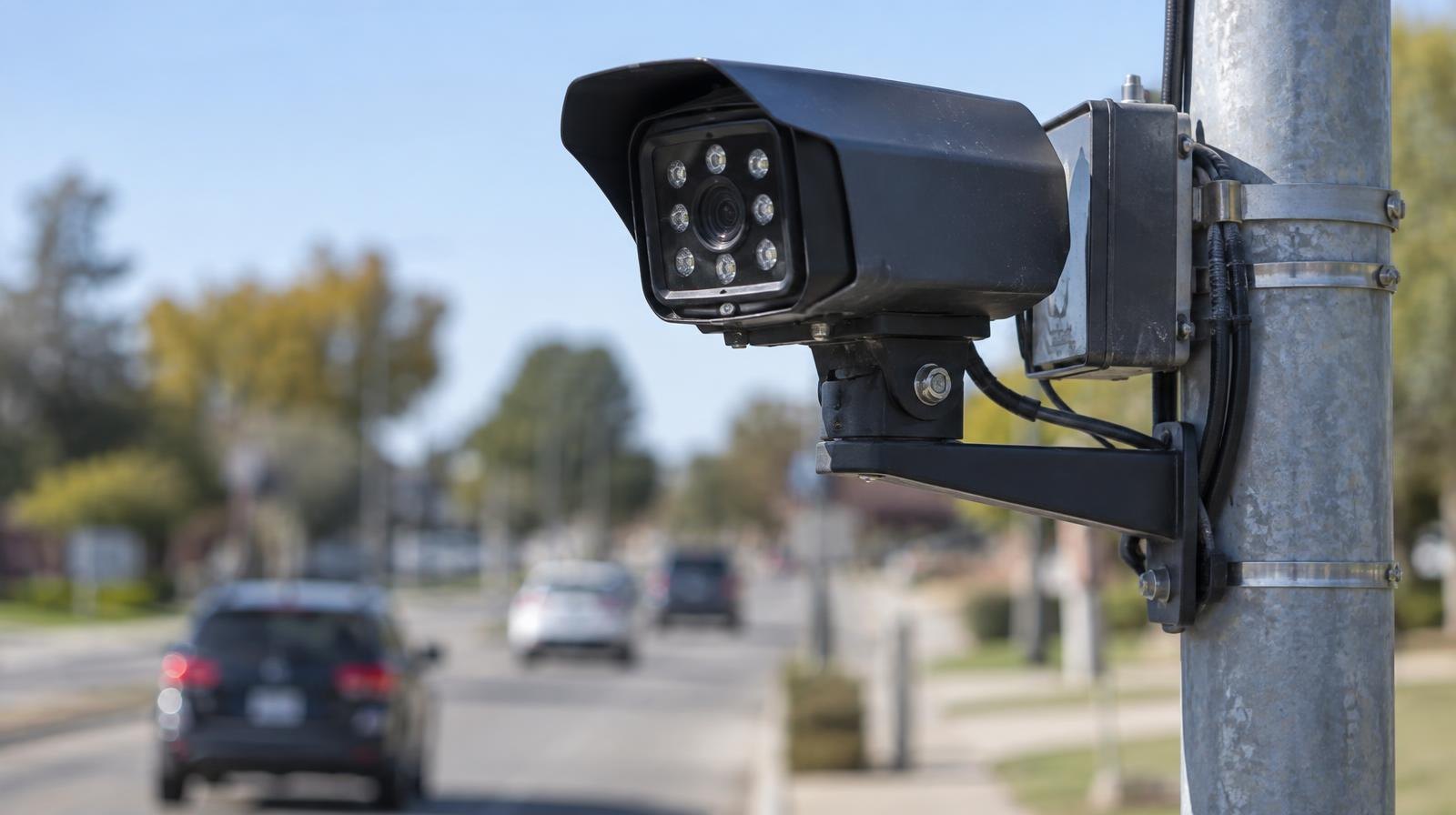
Police in Overland Park, Leawood, Prairie Village, Mission and Merriam operate hundreds of license plate reader cameras with no Kansas law governing the programs. No state or federal statute sets rules for how long departments keep the data, who can access it or how often systems are audited.
A Johnson County Post investigation published Thursday, Oct. 1, found that local departments have written their own internal policies, often without direct oversight from elected officials. Some Johnson County departments have no official policy at all, the Post reported.
The gap stands in contrast to neighboring Missouri. Gov. Mike Kehoe signed Executive Order 26-18 on Sept. 16 requiring most plate data to be deleted within 30 days and banning vendors from selling Missouri-generated data, KMBC reported. No equivalent Kansas law or executive order appeared in public records as of Thursday.
How each city handles plate data
Overland Park runs the largest local network: 38 fixed Genetec cameras and 113 mobile Axon cameras on patrol vehicles. The department has used the technology since 2010 and stores data for one year. Access is restricted, logged and periodically audited by the Professional Standards Unit. Officers must enter a specific reason to pull plate records, according to the Post.
The department does not use Flock Safety cameras.
Leawood operates 13 fixed Genetec units at major intersections and also stores data for one year. Capt. Jason Ahring told the Post that policy revisions are underway "given the public concerns identified in the last few weeks."
Prairie Village runs 30 fixed Axis cameras in the city plus 25 in Mission Hills, paired with Genetec software. The department began using the technology in 2022 and stores all data locally on its own servers for 90 days. Access is logged and audited semiannually. In 2024 alone, ALPR alerts helped recover 17 stolen vehicles and enabled 42 warrant-related interdictions, according to the city's ALPR transparency page. Prairie Village does not use Flock cameras.
Mission started its program in 2024 after receiving a U.S. Department of Justice grant. It has 22 fixed Genetec cameras with 90-day retention. Access is limited to trained officers, logged and audited quarterly.
Merriam has used plate readers for about 10 years and operates 19 fixed Genetec cameras. It keeps data up to 180 days. Other agencies must formally request access and document a specific reason. Audits are completed quarterly.
Sheriff's office and the Flock question
The Johnson County Sheriff's Office operates about 50 cameras: 45 from Genetec, three Flock Safety units and three LSAG mobile units. It is the only local agency in the Post's investigation that uses Flock hardware. Data is retained for 90 days, and every search must include a case number tied to the employee who ran it, according to the sheriff's office ALPR FAQ page.
Sheriff Byron Roberson said on the FAQ page, published Sept. 17, that the technology has helped deputies locate missing people, recover stolen vehicles and apprehend an armed man wanted after threatening a daycare.
Flock's cameras feed data into a cloud network accessible to subscribing agencies nationwide. That model drew public pushback in Gardner, where the city council in August decided to let its Flock leasing contracts expire. Gardner Police Chief Kelly Herron disabled access to the Flock cameras, had enacted a new policy on the use of all ALPR cameras, and had conducted an audit, the Post reported.
Privacy advocates want tighter limits
Rindala Alajaji, associate director of state affairs for the Electronic Frontier Foundation (EFF), told the Post the organization views ALPRs as fundamentally harmful.
Alajaji told the Post the organization's position is that 'this ALPR mass surveillance should not exist.'
EFF recommends departments impose short deletion windows, require a warrant or probable cause to add plates to a "hot list" of tracked vehicles and conduct regular internal and annual external audits. Alajaji pointed to New Hampshire, which requires plate images that don't match the hot list to be deleted within three minutes.
Concerns about misuse are not hypothetical. A former Bonner Springs police detective was accused of using surveillance technology to track his wife, the Post reported. Earlier in 2026, KCUR reported that Lenexa police used ALPR cameras to monitor Canyen Ashworth, a resident who had written a column critical of the department. No charges were filed against Ashworth.
The issue came up at a Johnson County Post candidate forum on Sept. 22 for Kansas House Districts 19, 24 and 28, which cover parts of Overland Park, Leawood, Prairie Village, Merriam and Mission.