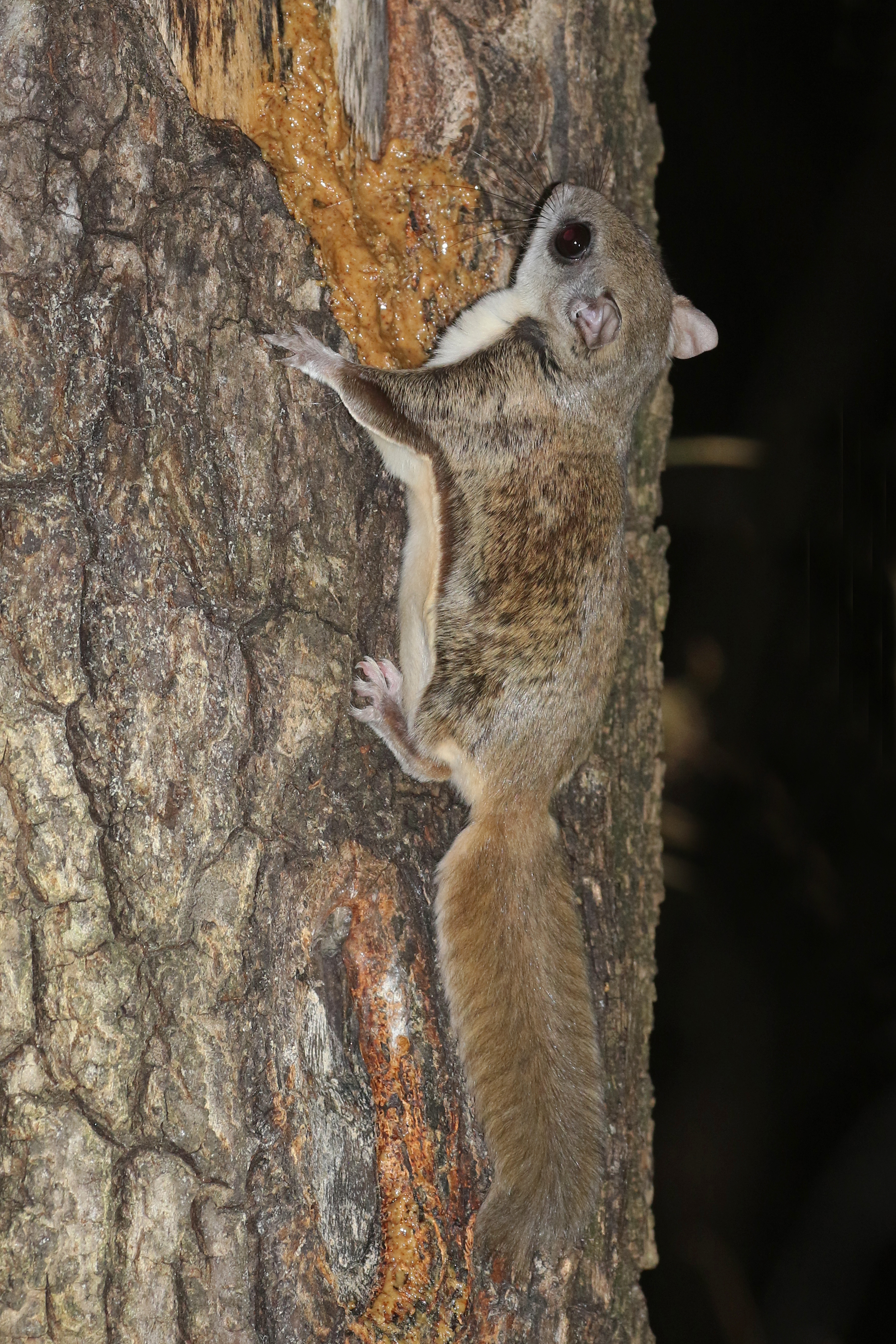
Two independent studies found evidence of Southern Flying Squirrels living in at least four Johnson County parks, including three run by JCPRD.
Kansas State University graduate student Lydia Robbins and KSU Professor Adam Ahlers deployed 1,113 trail cameras at 300 sites across eastern Kansas over three years. The effort, funded by a Kansas Department of Wildlife and Parks grant, detected the squirrels at Heritage Park, James Place Park in Overland Park, the Lake of the Forest community in Edwardsville and in Kansas City, Kan., according to a JCPRD blog post by David Markham, republished by the Johnson County Post.
"From what we are seeing, they are widespread in Eastern Kansas but have low abundances. So, overall, they are fairly rare," Robbins said.
The species had not been studied in Kansas in more than 40 years, Robbins said, despite being on the state's List of Species in Need of Conservation since 1987. Kansas sits on the western fringe of the Southern Flying Squirrel's range, making the population more vulnerable, according to the JCPRD blog post.
A separate study led by Johnson County Community College (JCCC) Environmental Science Lab Instructor Stephanie Ferrero found evidence of the squirrels at Cedar Niles Park and Shawnee Mission Park. Ferrero's team set up 12 monitoring stations in late 2025 and early 2026, each with a trail camera aimed at a tree baited with suet.
At Cedar Niles, the team captured one trail camera photo of a suspected flying squirrel and two acoustic ultrasonic recordings. At Shawnee Mission Park, one acoustic recording was identified, though no squirrels appeared on cameras.
The team also deployed 12 acoustic monitors from biologist J.T. Layne with Stantec Consulting. Each monitor detected sounds above 20 kilohertz, beyond the range of human hearing, and ran for four weeks at a time. Johnson County Park and Recreation District (JCPRD) Wildlife Biologist Matt Dear assisted with equipment and field setup.
Ferrero's team also checked Antioch Park, Thomas S. Stoll Park and the city of Overland Park's Quivira Park but found no flying squirrels at those sites.
The JCCC study was funded in large part through a National Science Foundation grant secured by JCCC microbiology professor Heather Seitz and chemistry professor Melanie Harvey. That grant established a course-based undergraduate research experience, or CURE, program. Students developed their own projects within the larger study and presented findings to local elementary school students, sometimes dressing up in a flying squirrel costume.
Southern Flying Squirrels weigh 2 to 3 ounces and measure 8-1/2 to 9-7/8 inches long, including a 3- to 4-inch tail. Their most distinctive feature is the patagium, a cape of loose skin stretching from wrists to ankles that forms a gliding membrane. They are nocturnal, most active in late spring through early fall, and depend heavily on oak and hickory trees for food and tree cavities for nesting.
They also glow. The squirrels biofluoresce red under ultraviolet light, though scientists do not yet know why.
JCPRD, the largest landowner in Johnson County, maintains 10,500 acres, about 86% of which are natural areas, according to a January 2026 natural resources plan update. The district's updated plan, accepted by the Board of Park and Recreation Commissioners on Nov. 19, 2025, sets a goal to actively manage more than 7,000 acres of natural areas by 2035.
Residents hoping to spot a flying squirrel should look for stands of large oak and hickory trees at dusk, Ferrero said. The squirrels produce a birdlike chirp, but some of their calls are inaudible to humans. The key distinction from bats, according to the researchers: a flying squirrel shoots from tree to tree in a glide, while a bat flies freely.
For more on JCPRD parks and programs, call 913-831-3359.