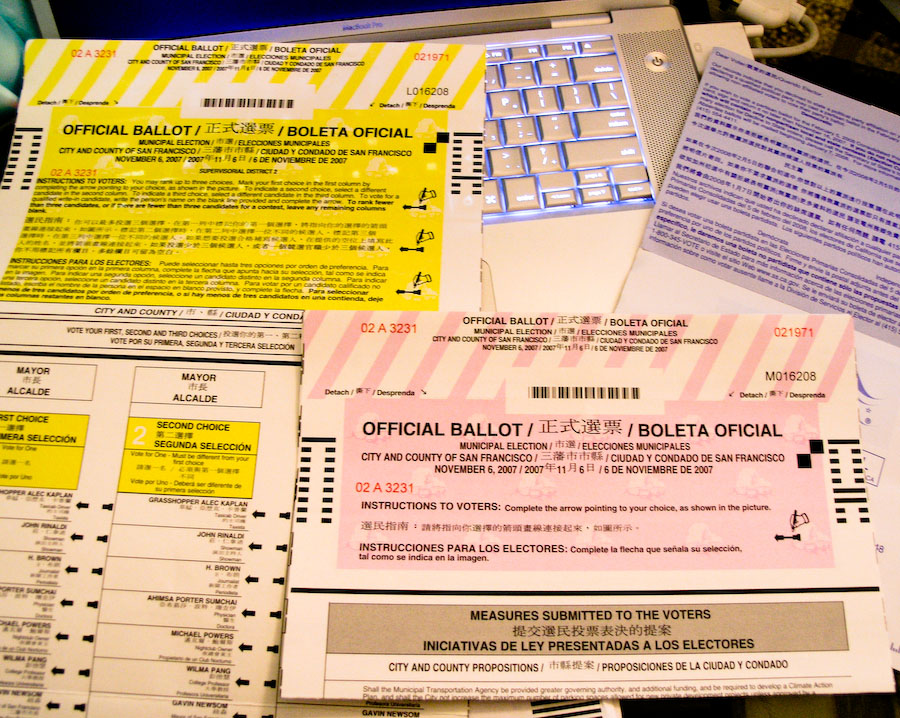
Johnson County poll workers begin hand-counting ballots Monday morning in five races where margins fell within 1% after the Nov. 3 midterm election.
The audit covers the governor's race, secretary of state, attorney general and two state House districts. It is the largest such review in the state because Johnson County has more ballots than any other Kansas county, according to The Kansas City Star.
Johnson County Election Commissioner Connie Schmidt said in an email to the Star that "190 bipartisan poll workers" will count ballots Monday morning. The Johnson County Post separately reported Schmidt described the staffing as "a minimum of 60 bipartisan teams of two."
The county originally planned to start its routine post-election audit on Tuesday, Nov. 10. Schmidt said the start was moved up a day because of the expanded number of races and ballots that needed review, according to the Johnson County Post.
Counting begins at 9 a.m. at the Johnson County Election Office, 2101 E. Kansas City Road in Olathe. The audit is open to the public, according to a county press release.
Schmidt said she expects the audit to finish by Tuesday, Nov. 10, the Johnson County Post reported.
What triggered the audit
Kansas Secretary of State Scott Schwab announced Wednesday, Nov. 4, that six races statewide had triggered close-race audits under K.S.A. 25-3009. That law requires a manual hand count of ballots in 10% of randomly selected precincts when unofficial results show a margin of 1% or less, according to the county press release.
Five of those six races require auditing in Johnson County: governor, secretary of state, attorney general, Kansas House District 27 and Kansas House District 117. The sixth, House District 40, is in Leavenworth County.
The Johnson County Election Office held a random draw Nov. 5 to select the precincts, the Johnson County Post reported.
The races
The governor's race is the highest-profile contest under review. Democrat Cindy Holscher claimed victory over Republican Senate President Ty Masterson, but the margin remains razor-thin. As of Nov. 5, Holscher led 549,974 to 542,929 statewide, according to figures the Johnson County Post reported from the Secretary of State's office.
Masterson posted a statement that stopped short of conceding. "The first count does not seem to be going our way, but the margin is narrow enough that Kansas law calls for another look, and we'll let that process finish," Masterson said, according to the Kansas City Star's earlier reporting.
In House District 27, Democrat Sara Kiewiet led Republican Sean Tarwater by 42 votes as of Nov. 5: 6,867 to 6,825. In House District 117, Democrat Brandon Holland led Republican Adam Turk 6,601 to 6,467.
Bryan Caskey, election director for the Secretary of State's office, told KSHB that this is the most races Kansas has had under the close-race audit process, which started in 2022.
What comes next
An audit is not a recount. Recounts must be requested by a candidate and can happen only after county canvassing boards certify final results, the Johnson County Post reported.
Johnson County's canvass is scheduled for Friday, Nov. 13, when the county commission, acting as the board of county canvassers, will certify the midterm results. All audits statewide must be completed before county canvasses, which are required by Nov. 16.